When Free Courses Aren’t Free: A Motivation Autopsy
Category: edci335 | blog post 1
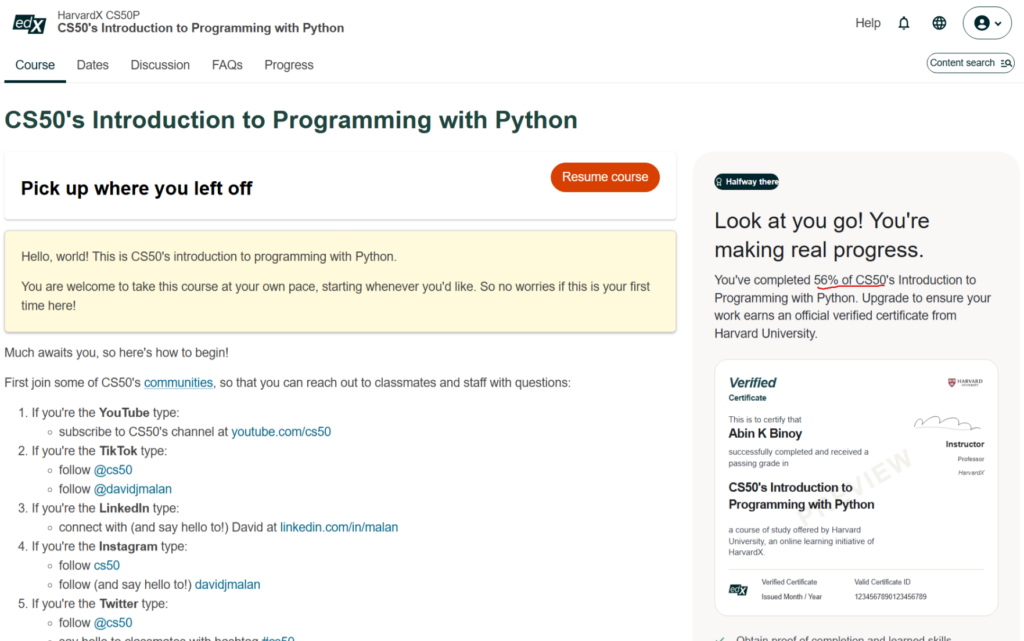
In September 2025, fresh into my first term of Software Engineering at UVic, I made two ambitious promises to myself. I was going to finish Harvard’s CS50x on the side, and I was going to grind through Telusko’s Java course on YouTube. Eight months later, I’m sitting at about five CS50 lectures in and somewhere between 10–20 Telusko videos. Neither finished. Both abandoned.
This is the autopsy.
What pulled me in
The pull was real. CS50 had the credential that famous Harvard certificate I could put on my LinkedIn. Telusko was the build-a-project pipeline I imagined would carry me into my first co-op. Both promised what Ertmer and Newby (2013) would call clear cognitive gains: structured knowledge, transferable skills, a mental model of programming that my UVic courses alone wouldn’t give me fast enough.
Where it broke
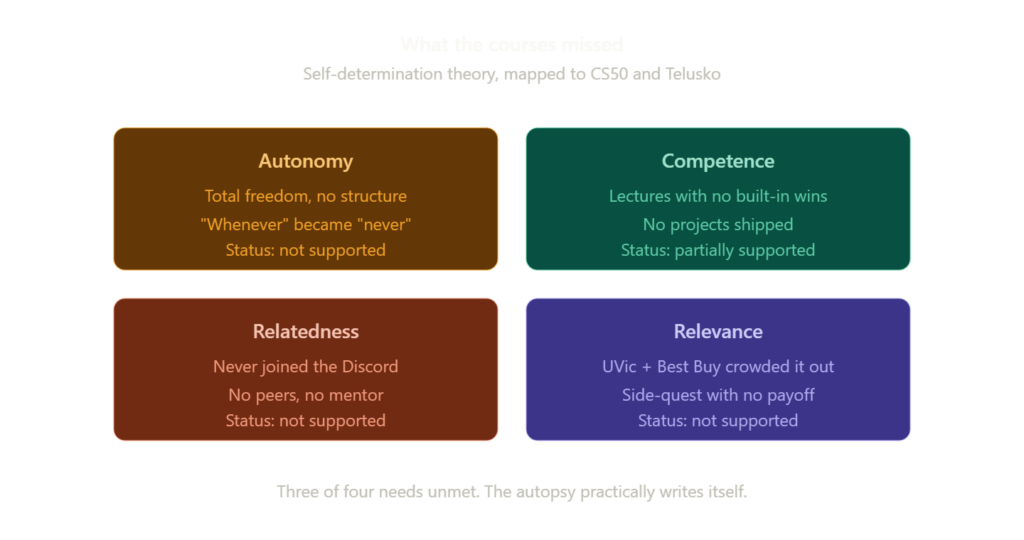
The first crack was autonomy turning into aimlessness. CS50 and Telusko handed me total freedom watch whenever i want, code whenever i wish, finish whenever i feel to and that “whenever” became “never.” Without deadlines, there was no friction pushing me forward.
The second crack was relatedness. Connectivism takes the same problem and zooms out. Weller (2020) describes it as learning through networks, you grow by being plugged into other learners, mentors, and communities. I wasn’t plugged into anything. CS50 has an active Discord. I never joined it. Telusko’s comment section is full of learners helping each other. I never posted. I was technically in two of the biggest learning communities on the internet, and I treated them like passive TV.
The third crack was the most predictable one which was school and Best Buy shifts swallowed my evenings. When the side-quest had no community, it was the first thing to get cut.
How I’d redesign it
If I were designing this for myself, I’d add three things: a fixed weekly schedule (autonomy with structure), one accountability partner in a Discord or study group (relatedness), and one tiny project per module so each lecture pays off immediately (competence + relevance).
The lesson I’m taking into EDCI 335: free courses aren’t actually free. They cost you exactly as much design effort as you’re willing to put in yourself.
References
Ertmer, P. A., & Newby, T. J. (2013). Behaviorism, cognitivism, constructivism: Comparing critical features from an instructional design perspective. In Foundations of Learning and Instructional Design Technology. EdTech Books. https://edtechbooks.org/lidtfoundations/behaviorism_cognitivism_constructivism
Weller, M. (2020). Connectivism. In 25 Years of Ed Tech. Athabasca University Press. https://read.aupress.ca/read/25-years-of-ed-tech/section/198057f5-1a3e-4436-a4b8-c6e1a3e0bd69
Recent Comments