Comments I left on my peers posts:
my comment 👇
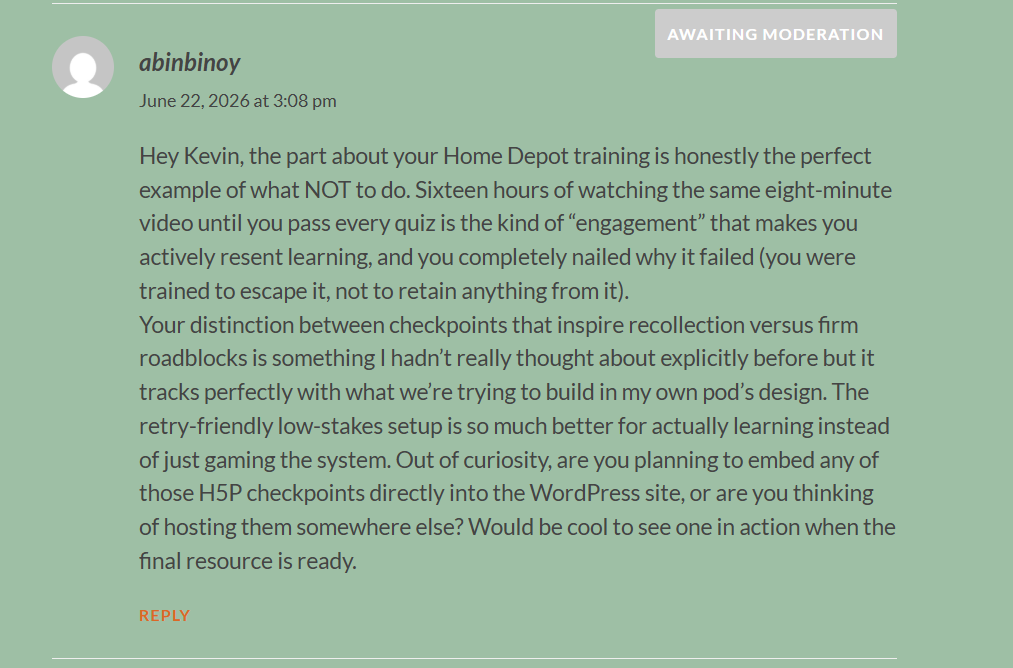
my comment 👇
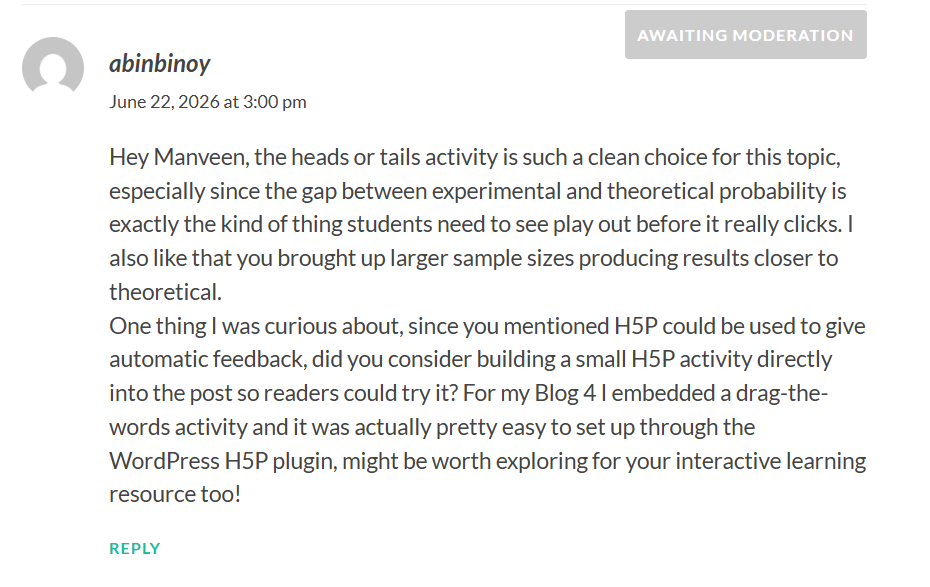
my comment 👇
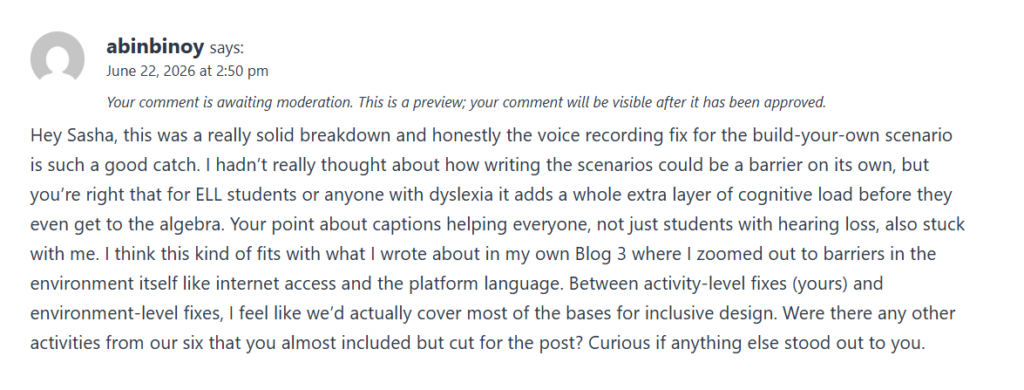
my comment 👇
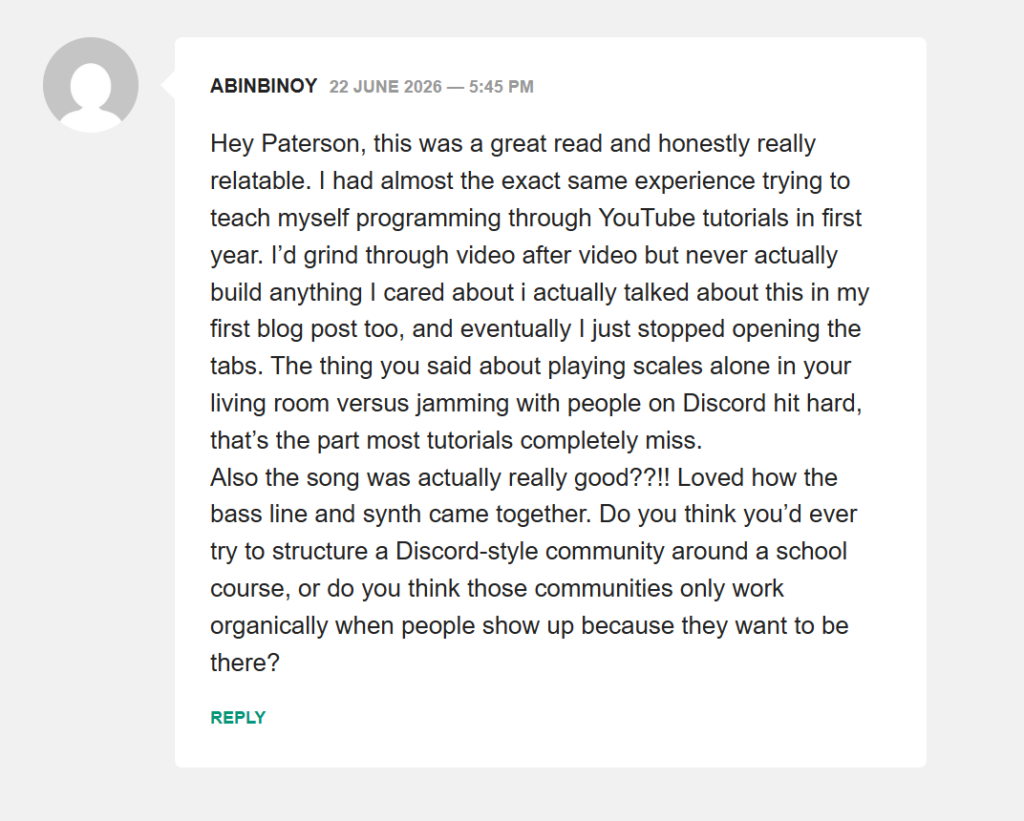
Comments I left on my peers posts:
my comment 👇
my comment 👇
my comment 👇
my comment 👇
POD G members :- Abin, Sasha, Paterson
Our Pod ( Pod G ) has decided to review Pod F
Our group reviewed the learning resource blueprint made by Sneh, Dilraj, Trevor for our EDCI335 class, titled “How Passwords Are Stored: Hashing, Salting, and Digital Security”. Overall, this blueprint was clear, well organized, and the content sounded relevant and engaging. The pacing of the three subtopics was laid out nicely, and each one built on the last in an intuitive way making the resource easy to follow. The learning activities are intriguing, making learners likely to engage in a meaningful way.
Some strengths that stood out in particular were the interactive learning activities that were included in subtopic 1 and 3. The “Hash It Yourself” activity incorporates a style of learning that is particularly engaging, where the learners get to experiment with watching passwords be hashed in real time and observe how hashing hides the original password without being able to be reversed. In subtopic 3, the “Good Company vs Bad Company” activity puts the learners into a fictional data breach so they can compare how two different companies handle the security of their user data, and how those differences affect the impact of the data breach. This is a great way to show the real world impact of cyber security and increase relevance of the resource. Both of these activities use cognitivist theories, helping learners organize and relate new information to existing knowledge in memory.
Another strength of the learning resource were misconceptions. They drew on existing false knowledge of students, and were general enough making it likely that most students have learned these misconceptions in their environments. They drew on students’ existing mental models, making learning activities to follow even more effective.
Similarly, the essential questions provided for each subtopic add another layer of strength. Each one is open ended and ties directly back to the learning outcome it is meant to guide. For example, the essential question in subtopic 2 “How does adding randomness to the hashing process fundamentally change the effectiveness of password protection?” does not just ask learners to define salting, but to think about why it changes the outcome. Questions like these encourage deeper reflection rather than memorization.
One area for improvement we noticed was that there wasn’t a learning activity listed for subtopic 2, which would be a nice addition to the resource. The other two activities sounded really engaging and relevant, so it would be nice to see something similar with the second topic. While reading the blueprint, the second topic seemed like it was a bit more complex than the other two, and as the assessment is a long answer style response, we think an activity to really solidify the content would be useful to ensure the learners understand the material. We saw that the material listed is a youtube video, so perhaps making this into an H5P interactive video could be an idea.
Another area that was a bit unclear as a person that doesn’t know much about hashing, is that before the “Hash It Yourself” learning activity, the hashing itself isn’t explained. The resource states why it should be done, but not what it actually is. The first time that we see what hashing really is, is during that activity. I think it would be nice to add a definition, and maybe a text example of: if this is your password – Divan@(stul5, then the hashed version of it will look like this: 102e1d26ce098bd855587b330432d13d. It gives the student a clear picture of what they are about to learn early on, potentially incentifying their interest.
One last area for improvement is the clarity of the outcome for learning this topic. While the blueprint explains how hashing and salting happens it is not always clear what the learner will actually be able to do with this knowledge once the module is complete. Is the goal to help learners build better personal password habits, or is it more about understanding the systems behind the scenes? A short line near the start of the resource explaining what learners will walk away with, for example: “by the end of this module, you will be able to evaluate whether the websites you use are protecting your password responsibly and adjust your own password habits accordingly” would make the purpose of the lesson feel more concrete.
Overall, we think this resource is well organized, relevant to the modern world, and the activities sound engaging and fun. As a final thought for the team to consider, all three assessments in the current draft (short answer quiz, written explanation, checklist) lean on traditional text based formats. Since the team has already planned for inclusive design including ELL learners and learners with ADHD, exploring an interactive H5P assessment for at least one subtopic like drag-and-drop matching or a quick interactive quiz could reduce the reliance on text-heavy writing and align the assessments more closely with the inclusive design goals already in the blueprint.
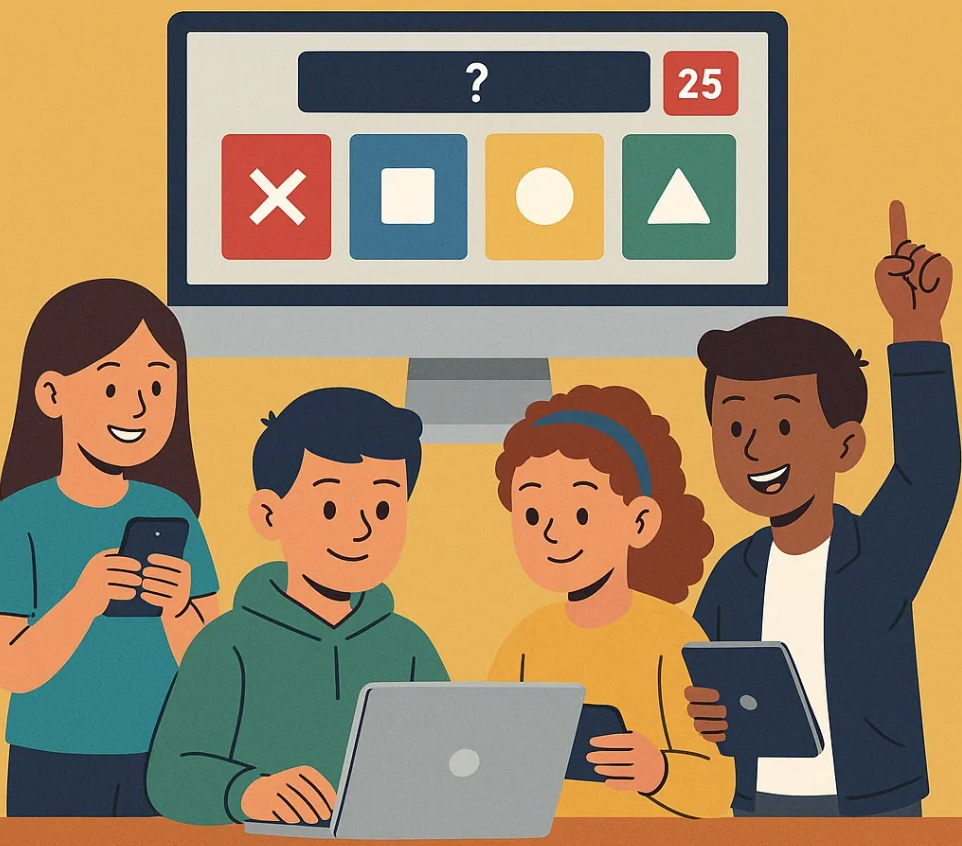
For our learning resource “Solving for Why,” one of the most promising tools for building meaningful interaction is H5P, a free and open-source framework for creating interactive HTML5 content. Specifically, I want to explore how H5P’s Drag the Words content type could support one of our core learning activities: matching real-world scenarios to their corresponding algebraic equations.
What kind of interaction does this H5P activity require from students?
H5P forces students to actively respond, they cannot progress without dragging each equation to its matching scenario. This is what Bates (2022) calls inherent interaction: the medium itself requires a response. Unlike a video where a student can passively watch, H5P makes engagement non-optional.
Try it yourself here is a sample activity I built for our learning resource:
In what way are students likely to respond on their own?
Beyond the built-in drag task, students engage in what Bates (2022) calls learner-generated interaction, mentally working through each scenario before dragging. A student reading “Two smoothies cost $16” will naturally reason through the math before matching it to 2x = 16. This internal reasoning is where the real learning happens.
What activity could follow the H5P interaction?
After completing the matching task, students could move into an H5P Fill in the Blanks exercise where they construct their own equations from a partially completed word problem. This is designed interaction (Bates, 2022) that builds a deeper skill: equation construction rather than just recognition.
How do students receive feedback?
H5P provides immediate, automated feedback, students see which matches were correct and can retry. This is manageable for instructors because it requires no manual grading and scales to any class size. For our target audience of Grade 9 students who may have math anxiety, the low-stakes, retry-friendly design reduces pressure while keeping the cognitive challenge intact.
References:
Bates, A. W. (2022). 10.6 Interaction. In Teaching in a digital age (3rd ed.). Tony Bates Associates Ltd. https://pressbooks.bccampus.ca/teachinginadigitalagev3/chapter/pedagogical-roles-for-text-audio-and-video/

When designing a learning resource, it is easy to focus on making the activities themselves inclusive while overlooking the barriers built into the environment where those activities live. In my group member’s Blog Post 3, they did an excellent job identifying barriers within two of our specific learning activities, video walkthroughs and build-your-own scenarios, and proposed fixes like captions and voice recording. In this post, I want to zoom out and look at the environment itself: the platforms, devices, and access conditions our learners face before they even reach an activity.
Our learning resource, “Solving for Why,” is hosted on Nearpod with supporting content on WordPress. Both platforms require a stable internet connection and a device with a modern browser. For many Grade 9 students across Canada, this is not a given. Students in rural communities, low-income households, or those sharing a single device with siblings face a real barrier before any learning begins. The Inclusive Design Research Centre emphasizes that inclusive design must “recognize diversity and uniqueness” and that as learners spread out from the hypothetical average, a single solution stops working (IDRC, n.d.). Assuming every student has reliable Wi-Fi and their own laptop is designing for the average, not for the reality.
To address this, we can apply UDL’s principle of multiple means of engagement by offering a low-bandwidth alternative (CAST, 2018). This could mean providing downloadable PDF worksheets that mirror the Nearpod content, so students without reliable internet can still work through each subtopic’s real-world scenarios and complete assessments offline. Nearpod also has a student-paced mode that reduces the need for a live connection, which we should enable by default.

Another environmental barrier is the platform’s language. Nearpod’s interface is in English, and our target audience includes English language learners. While the content itself can be simplified, the navigation and instructions within the platform cannot. Providing a short orientation guide like a one-page visual walkthrough of how to use Nearpod would reduce confusion and allow students to focus on the math rather than the technology.
Inclusive design is not just about what happens inside the lesson. It is about ensuring the path to get there is barrier-free too.
References:
CAST. (2018). Universal design for learning guidelines version 2.2 [Graphic organizer]. Wakefield, MA: Author. https://udlguidelines.cast.org/static/udlg_graphicorganizer_v2-2_numbers-no.pdf
Inclusive Design Research Centre. (n.d.). The inclusive design guide. OCAD University. https://guide.inclusivedesign.ca/
Direct instruction is one of the most widely used teaching approaches in North American classrooms. It is a teacher-centered method where the instructor explicitly presents information in structured, sequential steps, models examples, guides students through practice, and then assigns independent work (Rosenshine, 1987). Rosenshine described it as a systematic method with emphasis on proceeding in small steps, checking for student understanding, and achieving active participation by all students. It is efficient, predictable, and works well when the goal is to transfer a specific procedure or set of facts to learners quickly.

However, for our learning pod’s project – “Solving for Why: Connecting Real-World Experience to Algebraic Thinking in Grade 9”, direct instruction would work against what we are trying to achieve. Our entire resource is built around the idea that students already do algebraic thinking in everyday life, and the real learning happens when they discover that connection for themselves. Direct instruction, by design, removes that discovery. If a teacher simply tells a student that “2x = 16 means two water bottles weigh 16 pounds, so divide both sides by 2,” the student receives the answer but never builds the understanding of why that operation makes sense. Research supports this concern traditional instruction that focuses on memorization limits students’ ability to make meaningful connections and transfer knowledge to real-world problems (Anugraheni et al., 2025).
As Sasha discussed in her post on experiential learning, our project is grounded in constructivist approaches where students create meaning from their own experiences. Direct instruction sits on the opposite end of that spectrum. Similarly, Paterson highlighted in his post on inquiry-based learning that inquiry-based learning encourages students to ask questions and experiment with changing parameters, something a lecture-style format simply does not support.

That said, direct instruction is not entirely without a place in our design. Short, focused moments of explicit teaching, like briefly introducing what a variable represents before students explore scenarios on Nearpod, can scaffold the activity without replacing the discovery. The key is that direct instruction should support exploration, not replace it. In a technology-mediated environment like Nearpod, the design choices we make around interactivity and student agency are what turn theory into practice, and leaning too heavily on direct instruction would undermine the very purpose of the resource.
References:
Anugraheni, I., Gufron, A., & Purnomo, Y. W. (2025). The impact of realistic problem-based learning on mathematical connection abilities: Evidence from elementary schools in Indonesia. Cogent Education, 12(1). https://doi.org/10.1080/2331186X.2025.2523078
Rosenshine, B. (1987). Explicit teaching and teacher training. Journal of Teacher Education, 38(3), 34–36. https://doi.org/10.1177/002248718703800308
© 2026 Abin's Blog
Theme by Anders Noren — Up ↑


Recent Comments